
Energy storage for business – when does it really pay off?
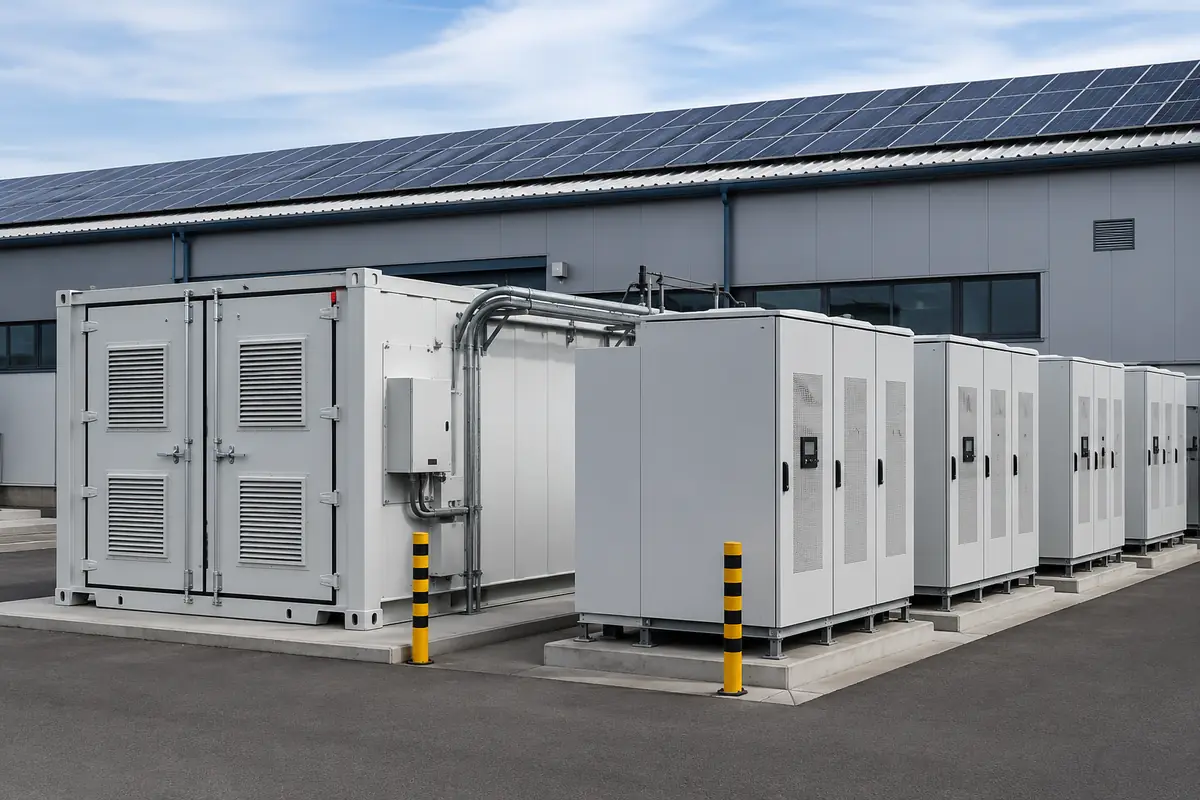
Energy storage can cut costs, increase the use of your own photovoltaics and safeguard production processes. There is one condition: it must be sized to the company's real operating profile, not to catalogue assumptions.
BESS, or Battery Energy Storage System, is a battery-based energy storage system. In practice it is not just a battery. A complete solution also includes a PCS power converter, a BMS battery management system, a supervisory EMS control system, protections, metering systems, cooling and communication with the site's electrical installation.
What business and technical problem is the energy storage system meant to solve at our plant?
Data first, device selection second
The basis of the analysis should be a full energy consumption profile spanning at least 12 months, ideally at 15-minute resolution. An hourly profile may be enough for an initial qualification, but when sizing BESS power, analysing short-lived peaks and peak shaving it can hide important information.
An annual 15-minute profile contains 35,040 measurement points in a normal year. It shows not only how much energy the company used, but above all:
- when the highest power draws occur and how long they last;
- how working days differ from weekends and how the individual shifts differ;
- when PV surplus arises;
- when the storage can charge and discharge;
- how many real, economically useful cycles it can perform over the year.
Without this analysis, sizing a storage system is like playing the lottery. You may hit the right capacity by chance, but far more often the system turns out to be too small, too large, or lacks the conditions to perform the number of cycles assumed in the financial model.
A good analysis should end with answers to two separate questions:
- Does the energy storage make economic and operational sense?
- How should it be designed so that the assumed benefits are actually achievable?
The first question requires working with data. The second additionally requires a site survey, verification of the infrastructure, grid connection conditions, the installation location, fire protection and the scope for integration with the existing installation.
1. Peak shaving – reducing power demand peaks
Peak shaving means using the storage to reduce momentary peaks in energy drawn from the grid.
If a plant exceeds its contracted capacity or approaches the limit of the available grid connection capacity, the storage can release energy at the critical moment and "shave" the peak seen from the grid side. This can reduce charges for exceedances, help keep the draw below a set limit, or allow new loads to be connected without immediately increasing the grid connection capacity.
Correct sizing requires two pieces of information:
- the exceedance power – how many kW or MW are missing at the peak;
- its duration – how much energy in kWh or MWh has to be delivered.
An exceedance of 300 kW lasting five minutes requires a different system than an exceedance of 300 kW sustained for two hours. In the first case the storage power may be decisive. In the second, a suitably large capacity will also be needed.
You also need to check how often the phenomenon recurs. A storage system sized for a single extreme event in the year may be economically unjustified. A system sized for recurring peaks that appear on every working day, on the other hand, can operate regularly and generate measurable savings.
2. Capacity fee – a cost you must not ignore
Large energy consumers pay not only for active energy and its distribution. One of the items on the bill is also the capacity fee.
In 2026 the base rate for consumers other than those billed at a flat rate is 0.2194 PLN/kWh, i.e. 219.40 PLN/MWh net. It is charged on energy drawn from the grid over 15 consecutive hours on working days, from 7:00 to the end of the hour beginning at 21:00. It does not cover Saturdays, Sundays and statutory public holidays.
The operator compares average energy consumption during peak hours with average consumption in the remaining hours of a given working day. On this basis the consumer is classified into one of the groups:
| Group | Difference in average consumption | Coefficient |
|---|---|---|
| K1 | below 5% | 0.17 |
| K2 | from 5% to below 10% | 0.50 |
| K3 | from 10% to below 15% | 0.83 |
| K4 | at least 15% | 1.00 |
A consumer in group K4 bears the full fee resulting from the rate and the volume drawn during peak hours, whereas in groups K1–K3 the fee is reduced accordingly.
Can storage help? Yes. By releasing energy during peak hours and scheduling charging outside the peak appropriately, it can even out the daily profile. This does not mean, however, that every plant will automatically move from K4 to K1. You have to analyse each working day, the charging options, the power reserve, the storage's other functions and the amount of energy available to shift.
The bill alone shows the amount of the fee already charged, but it does not allow you to reliably simulate how the battery would behave. For that you need an interval profile.
3. Capturing PV surplus
The most common use of energy storage in Polish businesses is capturing surplus PV production and using it later.
The first signal is energy fed into the grid, visible in the metering data or settlements. The situation is more difficult when the installation operates with an export limiter. Some of the potential production may then be curtailed by the inverters and will not appear either as consumption or as energy fed into the grid.
In such a case it is worth comparing:
- the energy consumption profile at the metering point;
- production data from the inverters;
- data on power limitations;
- available data on energy lost through production curtailment.
Periods in which the draw from the grid falls almost to zero may indicate that current PV production covers the site's entire demand and that there is potential for further, unused production. This is not conclusive proof, however; the data from the PV installation has to be checked.
Storage should be sized to the economically useful part of the surplus, not automatically to its maximum value. Trying to capture the last few kilowatt-hours that appear only sporadically may require a considerable increase in capacity that will remain unused for most of the year.
In many projects the economically sensible point lies in capturing around 75–85% of the available surplus, rather than an expensive chase after 100%.
4. Backup – emergency power for critical processes
A BESS can protect a plant against short voltage dips, keep selected equipment running until a generator starts, or provide longer operation of a separated part of the installation.
Not every grid-connected storage system has an emergency power function. Operating during a power outage may require:
- an island-mode function and the ability to form voltage on its own;
- transfer switching automation and proper protection coordination;
- separation of critical loads;
- an energy reserve maintained in case of failure.
Sizing should start with an analysis of the events: how often outages occur, how long they last, whether they are total, which processes must run without interruption, what the inrush current of the loads is and after how long a generator can be started.
Backing up the entire factory is often unjustified. Providing energy for controls, cooling, pumps, ventilation, IT infrastructure or the safe shutdown of a line, on the other hand, can have very high value.
The system should not operate at the edge of its permissible power for long periods. Load surges, inrush currents, temperature, the decline in available capacity over time and the required safety margin all have to be taken into account.
5. Arbitrage – buy cheap, use it when it is dearer
Arbitrage means charging the storage during hours of low energy prices and discharging it during hours when energy is expensive. Large price swings on the Day-Ahead Market have made it one of the most widely discussed uses of BESS.
The problem is that many calculations compare only the cheap and expensive exchange price. They omit:
- distribution charges and the capacity fee;
- losses arising from the efficiency of the whole cycle;
- the cost of battery wear and capacity degradation;
- the cost of servicing, balancing and commercial handling;
- OSD constraints and the capacity reserve for other functions;
- the actual ability to buy energy at dynamic prices.
A high price spread alone does not determine profitability. The storage must have the conditions to charge during the cheap hours. If a plant draws power close to its contracted capacity or the technical connection limit around the clock, it may not have the reserve needed to charge.
Arbitrage should be analysed against the site's real profile, price data, RTE efficiency, SoC and DoD constraints, the planned degradation and the whole life-cycle costs. You also have to check the grid connection conditions, equipment compatibility and the EMS control logic.
How many cycles should the storage perform?
The number of cycles must not be an assumption entered into a spreadsheet just to shorten the payback period.
In projects using PV surplus, a rough reference point may be around 180–195 cycles per year with a five-day working week and around 220–250 cycles with seven-day-a-week operation. This is not a universal rule, however. The number of cycles depends on the weather, PV capacity, production profile, storage capacity, the plant's consumption and the chosen control approach.
One full cycle per day may be justified. Two cycles per day are not a mistake by definition either, but they require a more detailed model. You have to calculate:
- the guaranteed number of cycles or energy throughput;
- the capacity decline in successive years;
- the effect of temperature and depth of discharge;
- the cost of potential expansion or module replacement;
- the net revenue attributable to each additional cycle.
More frequent charging and discharging accelerates wear. If a project is meant to run for 10–15 years, you must not assume that the capacity available in the first year will remain unchanged for the whole period. You should work with the degradation curve and the guaranteed end-of-life capacity, not solely with the catalogue capacity.
For a C&I plant, a larger storage system operating more shallowly and less often will often be more sensible than a smaller system run daily at the edge of its parameters. The choice, however, should be decided by the cost of energy delivered over the whole operating life and the value of the functions performed.
Stand-alone installations, built as independent market assets, are a separate case. Their economic model, risks and mode of operation differ from those of a storage system operating behind the meter of an industrial plant.
Let us not forget TCO and the installation site
The purchase price is only part of the cost. The analysis should also include:
- servicing, inspections and spare parts;
- system efficiency and auxiliary consumption;
- degradation and the anticipated replacement of battery modules;
- EMS updates, insurance and financing costs;
- response time and the availability of servicing in Poland.
Once profitability is confirmed, a site survey should be carried out. You need to check the installation location, transport and service access, connection options, cable routing, fire protection, environmental conditions and the insurer's requirements.
When does energy storage really pay off?
Energy storage makes sense when:
- it solves a specific, quantified problem;
- it is sized on the basis of a full consumption profile;
- it has real conditions for charging and discharging;
- it performs a sufficient number of economically justified cycles;
- the model accounts for losses, degradation, servicing and grid constraints;
- its functions do not compete for the same capacity at the same time;
- the analysis assumptions can later be reproduced in the EMS control.
At MPL we start by answering the question "is it worth it?", and only then move on to "how do we build it?". When a project can be calculated on the client's own data, there is no reason to base a multi-million decision on averages.
Let us size your storage on real data
Send us your consumption profile and we will tell you whether energy storage pays off and how to design it. An engineer answers, not a call centre.
Book a call